
QSAP Alumni Story Series
After Afghanistan’s government collapsed in August 2021, the American University of Afghanistan (AUAF) was forced to close, leaving thousands of students without a path to continue their education.
In response, AFF and its partners launched the Qatar Scholarship for Afghans Project (QSAP), enabling displaced AUAF students to resume their studies abroad. Today, more than 200 QSAP scholars have graduated and rebuilt their futures.
In our monthly QSAP alumni story series, we highlight the journey of those graduates now giving back to their new communities.
Beyond access to education, toward real opportunity
Abed Ebady still remembers studying in Kabul, Afghanistan, as if it were yesterday, trying to understand how systems work and how they fail. Today, he works inside one, helping manage multimillion-dollar budgets at the College of Humanities & Social Science (CHSS) of George Mason University.
That shift from a student navigating uncertainty to a professional shaping institutional decisions defines his journey.
Growing up in Kabul, Ebady began his academic path in electrical and electronics engineering at Kabul University before continuing his studies at the American University of Afghanistan (AUAF), where he expanded his focus to include business, communication, and policy.
His time at AUAF allowed him to engage with diverse perspectives and develop a broader understanding of how institutions shape society.
Following the events of 2021, his journey took him beyond Afghanistan to Pakistan and later to Bishkek, Kyrgyzstan, where he continued his studies while preparing for the next step. It was during this time that he learned about the QSAP, a turning point that allowed him to continue his education in the United States.
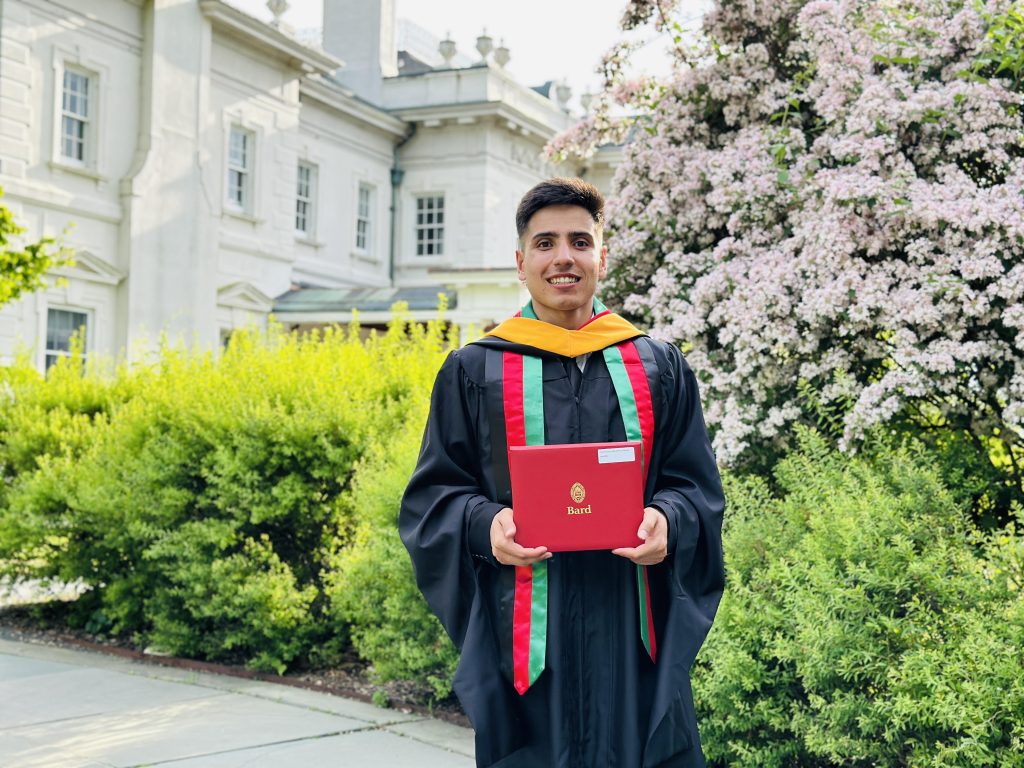
Through QSAP, Ebady went on to pursue a Master’s degree in Economic Theory and Policy at Bard College. Today, he works as a Financial Analyst at George Mason University, contributing to the same educational systems that once supported him.
- What did it mean to you personally to be accepted into the program, and how has QSAP shaped your life and opportunities?
Personally, being accepted into the program felt like a restoration of possibility. After witnessing the sudden breakdown of the systems I grew up with, the scholarship provided the stability I needed to focus entirely on my growth during an incredibly uncertain transition. It wasn’t just a gift; it was a trust that granted me a sense of purpose and a platform to pursue impact-driven work.
QSAP shaped my life by opening doors that crossed multiple borders, from Kabul to Bishkek and finally to Virginia, equipping me with the resources to pursue advanced studies in economics and finance. This support gave me the mental space to shift my perspective, moving from viewing economics as a rigid field to seeing it as a powerful tool for social equity and community service.
- What has your journey been like since graduating?
My journey since graduation has been one of immense growth, though it certainly came with its own set of hurdles. Adapting to a completely new country while lacking local professional experience was a significant challenge, especially as I worked to understand the nuances of the American workforce and the logistical complexities of building a life here from scratch. However, this integration was made possible through the unwavering support of my peers, family, and friends. Their guidance helped me navigate those initial uncertainties, allowing me to translate my academic background in economics and finance into a professional career.
- Is there a story, memory, or moment from your journey that stands out and that you’d like others to know?
There are so many small, quiet moments that I couldn’t possibly list them all — the long, late-night conversations and the new friendships that are now deeply etched in my memory. Those were the things that truly kept me going.
I remember one afternoon at the Levy Institute during the peak of spring. Looking across the Hudson River when the scenery was finally vibrant and the world felt whole again, I had a simple realization: that life has a way of renewing itself if you give it enough time. In that moment, everything felt reawakened and aligned. It wasn’t about a specific goal or a degree; it was just the feeling that after so much movement and uncertainty, I was finally standing on solid ground, surrounded by a community that made the future feel like something to look forward to rather than something to fear.
- What do you wish people to understand about the importance of supporting education for Afghans in crisis?
Education for Afghans in crisis is not merely a philanthropic gesture; it is a strategic investment in the revitalization of a society’s most vital public utility: its human potential.
When a nation faces systemic breakdown, the immediate result is the involuntary unemployment of its resources and the marginalization of its talent. Supporting education breaks this chain of causality by transforming individuals from victims of displacement into architects of resilient economic frameworks.
I wish for people to understand that an educated Afghan youth serves as a bridge between specialized technical precision and the high-level policy insights required for domestic stability. By investing in this talent, you are fueling a ripple effect where the support given to one student eventually translates into the professional management of resources that serve thousands of others. Ultimately, education is the tool that redirects human flows away from speculative survival and toward constructive, community-focused endeavors that leave no individual behind.
- What are your hopes and dreams for the future?
My ultimate hope for the future is to see a world where we move beyond just granting rights and focus on expanding the actual capabilities of every individual to lead a dignified and fulfilling life. This is especially vital for Afghan youth and Afghan women and girls in particular; they must have the ability to be active participants in shaping their society, with the freedom to choose and realize the lives they have reason to value. True progress is only possible when we build that future together, ensuring that no segment of society is excluded from the process of Nation-building.
Looking at the world more broadly, I dream of a shift toward an abundance lens. By establishing the right guardrails, laws, and institutional incentives for both the public and private sectors, we can foster a global community that is both equitable and thriving.
My vision is for a society where people are not just surviving, but have the security and agency to explore their own potential and dedicate time to what truly inspires them. When people are empowered to follow their passions and use their creativity for its own sake, we unlock a level of human innovation that can truly transform the world.