
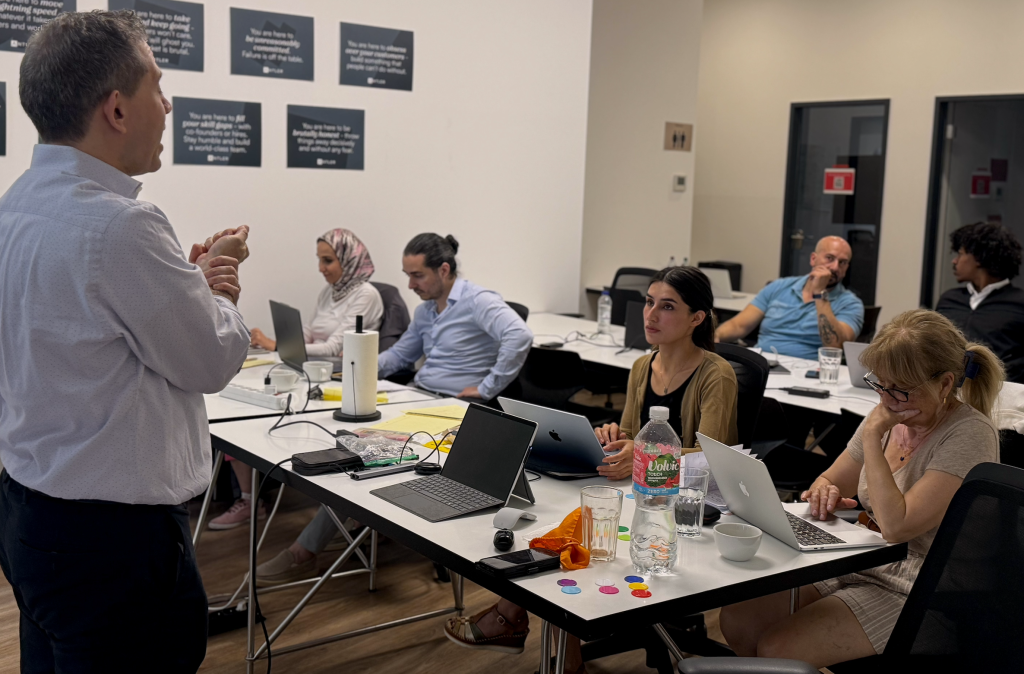
Laptops covered the tables as founders leaned over business models, challenged one another’s assumptions and practiced explaining the problems their ventures aimed to solve.
By the end of the week, those conversations had spilled beyond the classroom — over lunch, ice cream and visits to restaurants connected to participants’ communities.
Ian Mulholland, managing director of Ventures Beyond Borders, watched the dynamic change over the five days. “At the beginning of the week, a lot of the founders were quite unsure or nervous about presenting their idea or taking that risk to be vulnerable and share what they were struggling with,” Mulholland said. “By the end of it, the program really opened up people to accept not only new ideas, but also questioning their own venture.”
The Accelerator was the second stage of VBB’s 2026 entrepreneurship program for refugee founders. Incubated by the Afghan Future Fund, VBB began this year’s program with a Bootcamp that drew 227 applications and selected 158 founders from more than 20 countries of origin, including Afghanistan, Syria, Palestine, Ukraine, Sudan and Somalia.
Twenty-seven Bootcamp participants advanced to the Accelerator, which brought together founders for five-day sessions in Berlin, Washington, New York and Toronto.
While the Bootcamp focused on shaping and testing ideas, the Accelerator pushed founders to refine their solutions and business models.
From product to business
Founders arrived at different stages, from those already running businesses to those still developing an idea. Instructors adjusted the programming to their needs, but one principle remained consistent: Define the problem before becoming attached to the solution.
Across the four cities, founders worked through problem-solving, value capture, business models and operations, and growth and exit strategies. They also practiced pitching their ventures before investors and funders.
Three professors led the instruction: Arturo Osorio and Mukesh Patel of Rutgers Business School and Bill McConkey of the University of Toronto Scarborough. The Toronto cohort also met with five additional faculty members from the University of Toronto Scarborough.
For Faisal Popalzai, an Afghan technologist and co-founder of Payvand, the experience changed how he thought about the venture he was building.
Payvand is developing digital infrastructure to connect Afghanistan’s financial and commercial systems with the global economy. With a background in computer science, Popalzai said he naturally approached the venture by focusing on what its technology could do. The Accelerator broadened that perspective beyond the product itself.
“The VBB Accelerator helped me shift from thinking primarily about building a strong product to thinking more deeply about building a strong and sustainable business around it,” Popalzai said.
He said the program helped him to focus more closely on customer validation, business models and market positioning, as well as how to communicate Payvand’s value in a simple and compelling way.
Mulholland said many founders arrived confident that they had already identified the right solution. The program challenged them to test those assumptions and be willing to change course.
When the classroom became collaborative
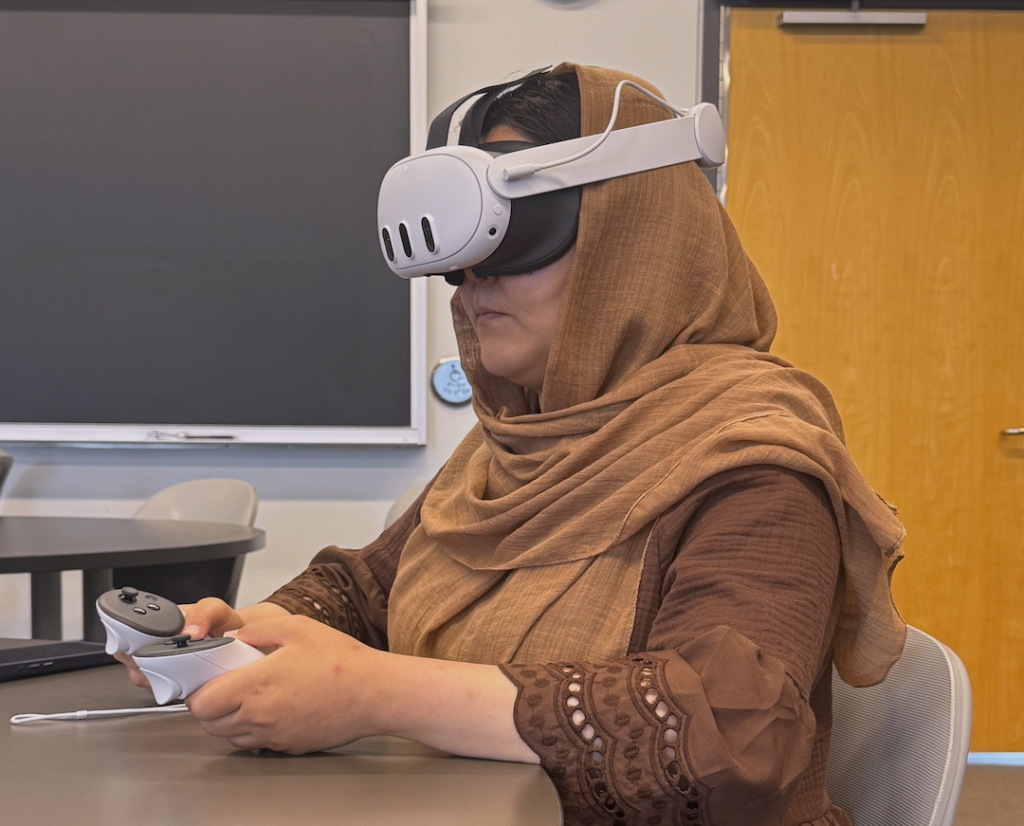
The sessions did not always go according to plan and Mulholland considered that a good sign. Discussions sometimes became so active that instructors used lunch breaks to adjust what they would teach next based on the questions and challenges emerging in the room.
“It was a lot of hands-on work,” Mulholland said. “Founders were very excited to workshop their ideas or help workshop other people’s ideas rather than just be passive listeners.”
That collaboration continued after the formal sessions ended. In Berlin, one participant who runs a fashion business held a pop-up exhibition. Other founders in the cohort showed up to support her and see the business they had been discussing in the classroom operating in the real world. In another case, a California-based participant traveled to Washington, connected with someone in the Afghan community and found a new business partner.
Participants also began forming peer groups around common industries and interests, including fashion and crafts. VBB is now working to expand those connections across the four city cohorts.
Mulholland said that a sense of community is particularly important for founders rebuilding professional and personal networks after displacement.
For Popalzai, those relationships were as important as the business training. Being surrounded by newcomer founders building ambitious ventures while navigating challenges many entrepreneurs do not face created a sense of connection.
“Talent and ambition are everywhere, but access to opportunity, networks, mentorship and capital is not,” Popalzai said.
Confidence beyond the business
For some participants, the week meant pitching to venture capitalists and funders for the first time. Others had to defend ideas they had spent months or years developing — and decide what needed to change.
For Popalzai, questioning his assumptions ultimately strengthened his confidence. “By the end of the program, I felt more confident pitching the ecosystem, speaking with potential investors and partners, and defending our decisions while still being open to feedback and adapting when necessary,” he said.
Mulholland saw a similar shift across the cohorts. “The biggest change that a lot of people noted was just the confidence that they had in themselves, even more so than their idea,” he said.
What comes next
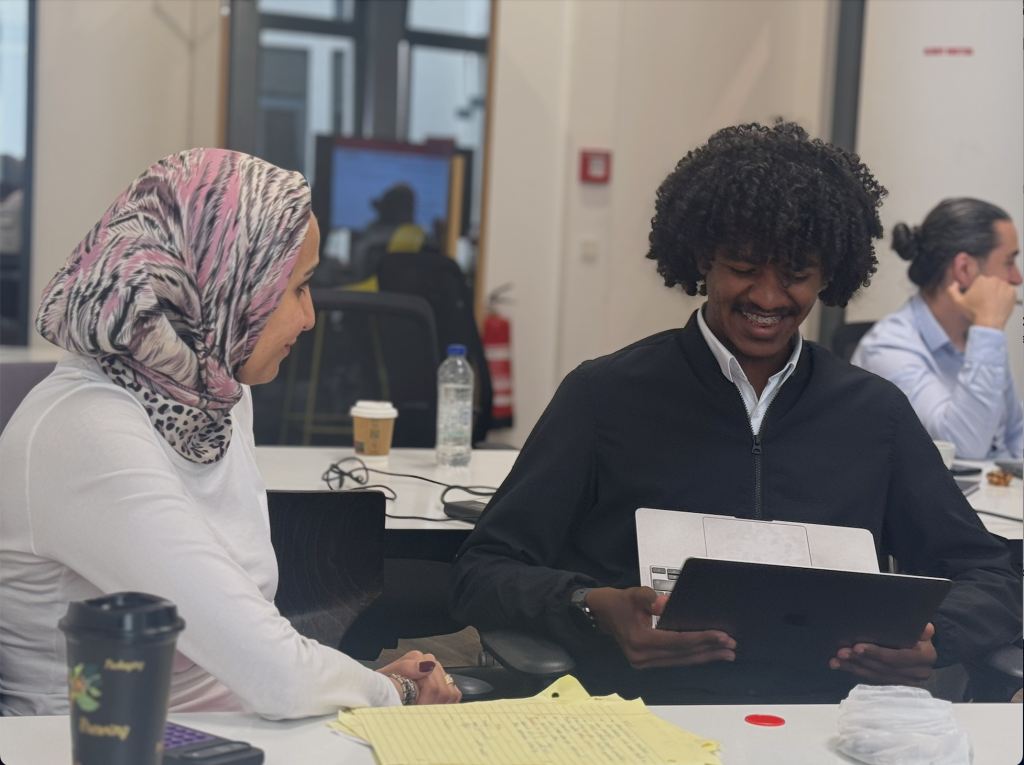
The Accelerator continues through December with two structured workshops each month, along with one-on-one mentorship, expert office hours, peer working sessions and connections with VBB alumni.
Participants can apply for seed grants, generally around $5,000, to test early-stage ideas. Later in the program, founders may apply for an investment round of up to $100,000 to scale ventures that have demonstrated early validation.
Some founders entered the program with established operations; others were still working out how to structure their organizations. But Mulholland said each founder brings something to entrepreneurship that cannot be taught in a classroom.
“The ability to adapt and to rebound and change is something that gets thrown around a lot in the entrepreneurship space,” he said. “But what we really appreciate is that people have it in their lived experience as well.”
For a program built around testing ideas and adapting when they do not work, that lived experience may be one of the founders’ most valuable assets.
