
This spring, 25 Afghan women graduated from universities across the United States through the Qatar Scholarship for Afghans Project (QSAP), representing 67% of the program’s graduating class.
Their achievement came as women and girls in Afghanistan continued to face severe restrictions on education. More than 3 million Afghan girls remain barred from studying beyond sixth grade and prohibited from attending universities.
For these graduates, earning a degree meant more than reaching a personal milestone. It was a reminder of what Afghan girls can achieve when given the opportunity to learn.
Rose Rahimi, Farzana Jafari and Ayda Haydarpour each followed a different path to graduation, but all three share a belief in the power of education and a message for the millions of Afghan girls still waiting for the chance to continue their studies.
Ayda Haydarpour

Ayda Haydarpour graduated from Virginia Polytechnic Institute and State University (Virginia Tech), with a degree in computer science after earning President’s List recognition twice, Dean’s List recognition five times and completing multiple internships and research projects focused on artificial intelligence, machine learning and virtual reality in education.
Born in Herat, Afghanistan, Haydarpour developed an interest in science and technology at an early age. She later joined the Afghan Girls Robotics Team, where she spent more than five years working on projects ranging from ventilators and automated wheelchairs to educational games and robots for international competitions.
The team gained international recognition, including being featured in Forbes 30 Under 30 and Teen Vogue’s 21 Under 21.
After the regime change in Afghanistan, Haydarpour continued her education in the United States through QSAP, where she expanded her research and technical experience while remaining committed to advancing educational opportunities for Afghan women.
“My research has focused on areas such as artificial intelligence, machine learning and virtual reality in education. I am also currently working on a project called Impact Afghanistan in collaboration with Brown University.”
Outside the classroom, she said she wanted to “give back in the same way others helped” her. To do so, she founded Education For Empowerment, an organization that provides Afghan girls and women with free online education, mentorship and skills training.
“Advocacy for girls’ education remains deeply personal to me because I know how much access to learning can shape a life,” she said.
Following graduation, Haydarpour began working full-time as a software engineer while pursuing an accelerated master’s degree in computer science with a focus on cybersecurity.
“This graduation means much more than earning a diploma,” she said. “It is proof that even when life becomes uncertain, education can still create new opportunities and new beginnings.”
Her message to Afghan girls who are currently denied education is one of hope and perseverance.
“Your dreams are still alive, even if others try to silence them,” Haydarpour said. “Keep believing in your future, keep learning in every way you can, and never doubt your strength. The doors closed today will not stay closed forever.”
Farzana Jafari
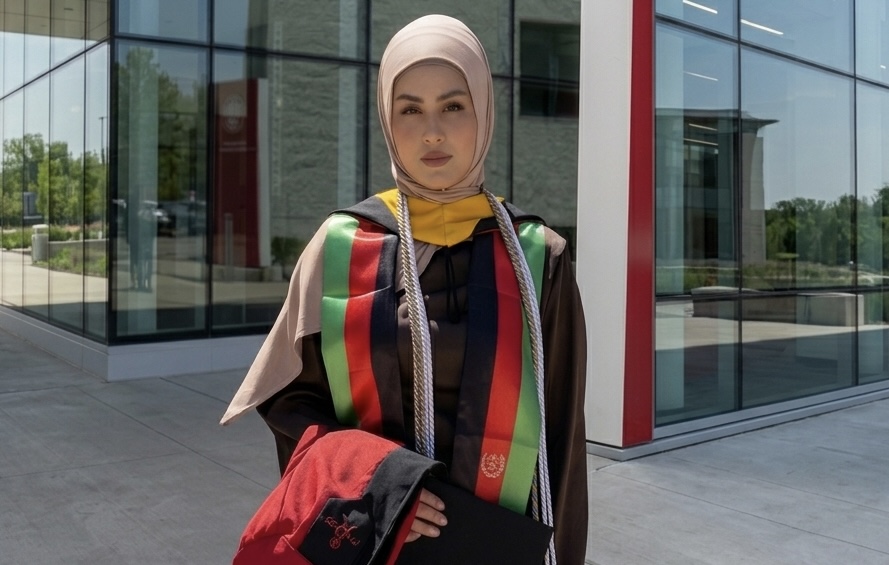
Farzana Jafari graduated with honors from Rutgers University, The State University of New Jersey, through the School of Management and Labor Relations, earning dual degrees in Human Resource Management and Labor Studies and Employment Relations.
During her undergraduate studies, she completed an honors research project. This fall, she will continue her education at Rutgers, pursuing a master’s degree in Human Resources Management.
Her family strongly believed in education, especially her father. “He always supported his daughters, and that made a huge difference in my life,” she said.
At the same time, she was aware of the challenges facing many Afghan women and girls.
“I wasn’t living in a bubble,” Jafari said. “I saw what was happening around me. I saw girls being told they couldn’t go to school. I saw child marriages. I saw women with so much potential being limited just because they were women.”
Believing education was the foundation for creating change, she enrolled at the American University of Afghanistan. Soon, her studies were interrupted after the Taliban takeover in 2021.
“When the Taliban took over, it felt unreal,” she said. “Everything just stopped.” Jafari spent several weeks living under the new regime before being evacuated to the United States through QSAP.
Reflecting on her evacuation, Jafari said, “I can’t even fully explain that moment; it was relief, but also heartbreak at the same time.”
The experience became a turning point.
“I remember sitting there thinking: I get this chance. But what about everyone else?” she said. “That thought never left me.”
“From that day, I made a promise to myself: I’m not going to waste this opportunity,” she said. “Every time I felt tired, overwhelmed or exhausted from balancing everything, I reminded myself: I’m not just doing this for me. I’m living something that so many girls are still being denied.”
“For many girls back home, something as basic as education has become a dream,” she said. “And that shouldn’t be the case.”
Addressing Afghan girls, Jafari said, “Please don’t give up. Your dreams are still yours.”
“No one can take that away from you,” Jafari said. “Hold on to them. Prepare yourself for the day things change, because they will. And until that day comes, just know this: We are here, and we are trying. We are speaking, we are working, we are pushing forward for you.”
Fatime Rose Rahimi
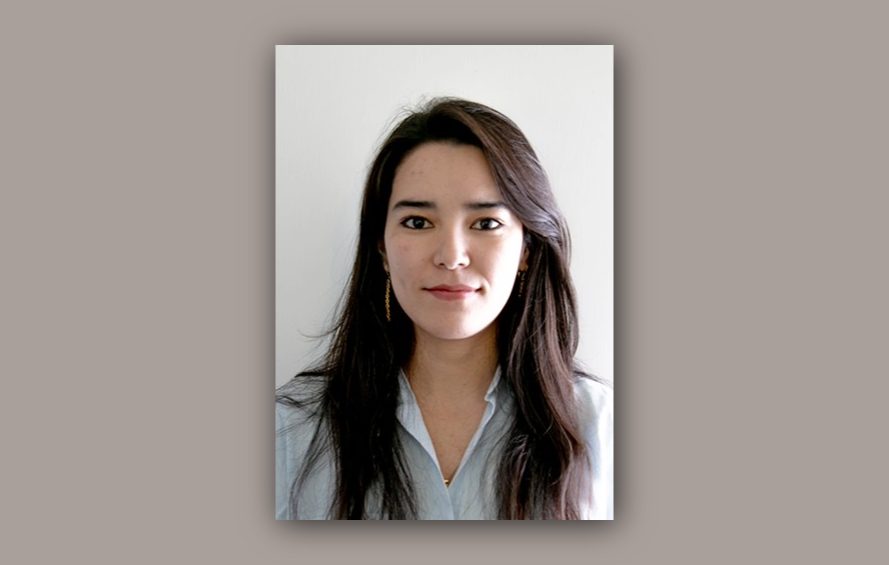
Fatima Rose Rahimi graduated from Bard College with a degree in computer science and mathematics after pursuing academic research, competing as a collegiate athlete and building a strong foundation in technology and quantitative analysis.
Originally from Bamyan and raised in Kabul’s Dasht-e-Barchi neighborhood, Rahimi grew up in a Hazara family that “viewed education as essential.” She said lifelong learning was deeply valued in her community and at home, where she was encouraged by her parents and two older sisters to pursue her education without limits.
“The question was never whether I would study,” Rahimi said. “The question was only how far I would go.”
Rahimi earned a full scholarship to the Asian University for Women in Bangladesh, where she studied for two years before returning to Afghanistan during the COVID-19 pandemic. She was in the country when Kabul fell in 2021 and was later evacuated alongside 147 other young Afghan women.
After arriving in the United States, she was offered placement at a university through the evacuation program but declined the opportunity.
“My family needed financial support, and I needed to work,” she said. “You cannot follow the crowd through your own life. You have to find what makes sense for your background and your responsibilities, even when others cannot see it yet.”
She spent the next nine months working as a case manager for newly arrived Afghan refugees, helping families find housing, apply for benefits and adjust to life in a new country while also supporting her family financially.
Rahimi later enrolled at Bard College on a full scholarship through QSAP, where she changed her major from politics, philosophy and economics to computer science while pursuing additional coursework in mathematics.
Outside the classroom, she joined the swim team despite having no competitive swimming experience. “I had to spend my first year learning how to swim with the coach one-on-one before I could compete,” she said. Rahimi went on to compete for three seasons in the Liberty League while working as a systems administrator assistant at the college.
During her junior year, she interned with Man Group’s quantitative technology team in Boston. The experience deepened her interest in statistics, financial markets and machine learning, eventually shaping her senior thesis, which focused on forecasting financial markets using Generative Adversarial Networks.
“Bard gave me more than a degree,” Rahimi said. “It gave me time to heal, to rebuild and to learn how to learn.”
Today, she believes education remains the most important pathway for immigrants and displaced students rebuilding their lives.
“Keep going,” she said to Afghan women. “Consistency matters more than intensity. Build one percent a day and the doors will open, even when nothing seems to be moving.”
The three women studied different subjects, attended different universities and followed different paths to graduation. Yet when asked what they would tell girls in Afghanistan, their messages echoed one another:
“Please don’t give up.”
“Keep going.”
“The doors closed today will not stay closed forever.”
